
You’ve probably walked into a room and felt something was off. Too bright. Too dark. Glaring in your eyes. Shadows in all the wrong places. You couldn’t put your finger on it, but the space just didn’t feel good.
Chances are, the problem wasn’t your furniture or your wall colour. It was your lighting.
Here’s the thing: most homes get lighting wrong. Not because people don’t care, but because nobody ever teaches us how to do it right. We buy a ceiling light, stick a bulb in, maybe add a floor lamp, and call it a day.
But good lighting isn’t about one fixture. It’s about a system. And once you understand the common mistakes, fixing them is surprisingly easy.
Let’s break down what most Aussie homes get wrong – and exactly how to fix it.

The One‑Light Wonder
The mistake: Relying on a single overhead light in every room.
Walk into most living rooms or bedrooms, and there’s one ceiling fixture trying to do everything. It blasts light everywhere at once – harsh shadows, no depth, zero personality. It’s like trying to cook a gourmet meal with only a microwave.
Why it’s bad: Single‑source lighting creates flat, unflattering spaces. Your eyes have nowhere to rest. The room feels like a waiting room or a garage, not a home.
How to fix it: Layer your light. You need three types:
- Ambient: General illumination (ceiling light on a dimmer)
- Task: Focused light for reading, cooking, working (floor lamps, desk lamps)
- Accent: Mood and decoration (small table lamps, wall sconces)
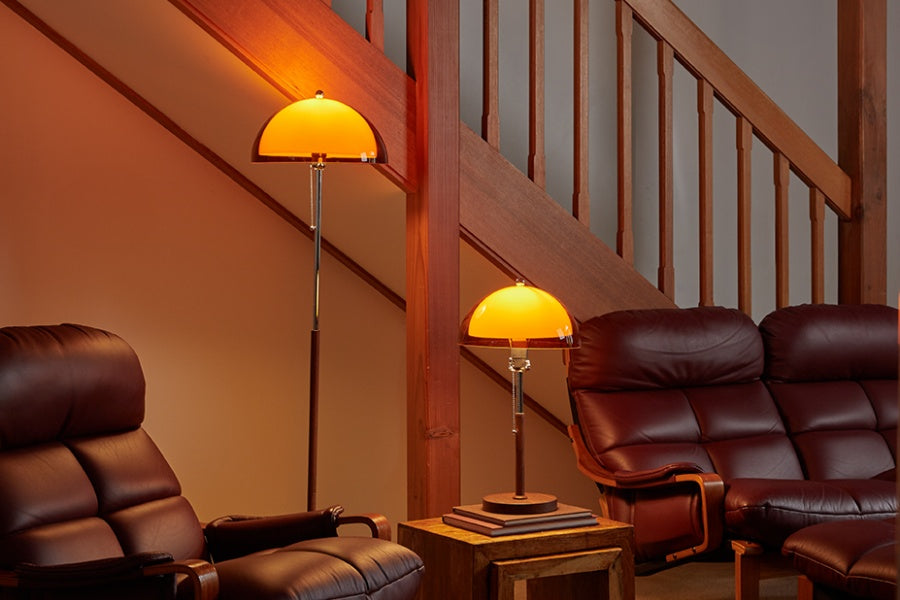
Add just one floor lamp to a corner and one small lamp on a side table. Suddenly your living room has depth. It feels intentional. It feels like you.
For a deeper dive, our guide on layered lighting walks you through the whole process.
All Lights, Same Height
The mistake: Every light source is at the same level – usually eye‑height or ceiling height.
When all your light comes from the same vertical plane, the room feels monotonous. No shadows, no highlights, just a boring blanket of brightness.
Why it’s bad: Our eyes crave contrast and variation. A room lit entirely from above feels clinical. A room lit entirely from table lamps feels bottom‑heavy.
How to fix it: Vary your heights.
- Ceiling lights for top‑down ambient
- Wall sconces at mid‑level (around 145cm – that’s the 57 rule)
- Floor lamps for low‑to‑mid glow
- Table lamps for intimate, human‑scale light
Mix them in the same room. Your eye will travel naturally, and the space will feel richer without adding a single piece of furniture.
The Cool White Invasion
The mistake: Using cool white or daylight bulbs (4000K and above) in living spaces and bedrooms.
Those bright, blue‑toned LEDs might feel “clean,” but they’re terrible for relaxation. They trick your brain into thinking it’s midday – alert, stressed, not ready to wind down.
Why it’s bad: Cool light suppresses melatonin, increases cortisol, and makes your home feel like an office or a supermarket. It’s fine for garages and task lighting in kitchens. It’s awful for anywhere you want to relax.
How to fix it: Switch to warm white (2700K) everywhere except maybe your kitchen prep zone. For bedrooms and living rooms, go even warmer – 2200‑2400K for evening lamps.
This is the cheapest, fastest fix on the list. Swap one bulb and see the difference.
For more on why warmth matters, our article on the science of cozy has the full story.
Ignoring Shadows and Glare
The mistake: Placing lights where they create harsh shadows or shine directly into your eyes.
That pendant hanging directly over your sofa? It’s casting shadows on everyone’s faces. That bare bulb pointing at your TV? Glare city. That floor lamp behind your chair? Useless.
Why it’s bad: Bad placement makes rooms uncomfortable without you knowing why. You squint. You move your chair. You turn the light off and sit in the dark.
How to fix it: Think about where the light is going, not just where the lamp is.Position reading lamps so the shade is at or slightly behind shoulder height, angled away from your face.
- Use shades that diffuse (fabric, frosted glass) instead of bare bulbs
- Bounce light off walls and ceilings for softer, indirect glow
- Move lamps until shadows fall where you want them – usually away from seating
Try this: move your floor lamp from the corner to beside your sofa, shade angled down. Instant improvement.

No Dimmers Anywhere
The mistake: Every light is either on at 100% or off.
Life changes moment by moment. Your lighting should too. You need bright light to clean or work, medium light to cook or chat, and soft, low light to wind down. Without dimmers, you’re stuck with one setting – and it’s almost always the wrong one for right now.
Why it’s bad: You can’t control the mood. Your room is either interrogation‑bright or pitch black. No in‑between means no flexibility.
How to fix it: Add dimmers everywhere.
- Dimmable bulbs in existing fixtures (cheapest option)
- Plug‑in dimmer cords for floor and table lamps
- Smart plugs with dimming (control from your phone)
Even one dimmable small lamp on your bedside table changes how you end every day.
Forgetting the Corners
The mistake: Only lighting the centre of the room.
Most people put their ceiling light in the middle and call it done. But corners – especially behind furniture or next to bookshelves – stay dark and shadowy. The room feels unbalanced. The edges disappear.
Why it’s bad: Unlit corners make rooms feel smaller and colder. Your eye gets drawn to the bright centre, and the rest feels like an afterthought.
How to fix it: Push light to the edges.
- Put a small table lamp on a console against the wall
- Tuck a floor lamp into a dark corner
- Use plug‑in wall sconces to light a blank wall
When the edges of a room glow, the whole space feels bigger, warmer, and more finished.

Choosing Looks Over Function
The mistake: Buying a lamp because it looks gorgeous – without checking if it actually gives good light.
We’ve all done it. That sculptural beauty with a tiny metal shade that casts one sad spotlight. That ceramic base with no space for a proper bulb. That “vintage” find that’s basically a nightlight.
Why it’s bad: Pretty lamps that don’t perform become dust collectors. You end up leaving them off and sitting in the dark. What’s the point?
How to fix it: Shop for both form and function.
- Check lumens (400‑600 for reading, 800+ for task)
- Look for diffusing shades (fabric, frosted glass, linen)
- Make sure it’s dimmable
- Consider adjustability – can you move the head or shade?
You can have beautiful and useful. Browse our collection of floor lamps for living room to see how we balance both.
The Quick Fix Checklist
Not sure where to start? Here’s your weekend plan.
Day one: Swap every cool white bulb for warm white (2700K). Cost: under $50. Impact: huge.
Day two: Add a dimmer. Start with your bedside lamp – use a smart plug or dimmer cord.
Day three: Move your floor lamp from the corner to beside your sofa.
Day four: Buy one small lamp for a dark corner or shelf.
Day five: Turn off your overhead light. Live with just lamps for one evening. Notice how different your home feels.
Congratulations – you’ve just fixed 90% of your lighting problems.
Why Homezee?
At Homezee, we believe great lighting shouldn’t require a degree in electrical engineering or a second mortgage. We design and curate lamps that are warm, functional, and easy to use – no tradie needed.
Whether you need a floor lamp for your living room, small table lamps for layering, or bedroom wall lights to free up nightstand space, we’ve got you covered.
Ready to fix your home’s lighting? Explore our full range of all lamps for sale and start your makeover today.
FAQs
1. What’s the single biggest lighting mistake people make?
Using one overhead light as the only source in a room. Add layers – floor lamps, table lamps, wall sconces – and suddenly the whole space feels warmer, deeper, and more intentional.
2. Can I fix my lighting without hiring an electrician?
Absolutely. Swapping bulbs, adding plug‑in lamps, using dimmer cords, and moving existing fixtures around are all DIY‑friendly. No wiring required.
3. What colour temperature should I use in my living room?
Stick to 2700K (warm white) for living areas and bedrooms. Avoid anything above 3000K – it will feel harsh and clinical. For evening winding down, go even warmer (2200‑2400K).
4. How many lamps does a typical living room need?
Aim for at least three sources: a ceiling light on a dimmer (ambient), a floor lamp next to seating (task), and a small lamp on a sideboard or shelf (accent). More is fine – just layer thoughtfully.
5. Is it worth buying dimmable bulbs if my fixture doesn’t have a dimmer?
Yes – but you’ll also need a dimmer. Use a plug‑in dimmer cord (plugs between the lamp and the wall) or a smart plug with dimming. Then your dimmable bulbs will actually be useful.
Have more questions? Reach out to our team at Homezee – we’re here to help you get your lighting right.